The Financial Industry Is Undergoing a Digital Transformation
The financial sector has experienced significant technological change over the past few decades, but few innovations have generated as much attention as blockchain technology. Originally introduced as the foundation for Bitcoin, blockchain has evolved into a broader technology with applications that extend far beyond cryptocurrency.
Financial institutions, technology companies, and governments are exploring how blockchain can improve efficiency, security, and transparency. As adoption grows, blockchain is increasingly being viewed as a tool capable of modernizing traditional financial systems and creating new opportunities for businesses and consumers alike.
The ability to record and verify transactions without relying entirely on centralized systems is one of the reasons blockchain has become such an important topic within the financial industry.
What Makes Blockchain Different
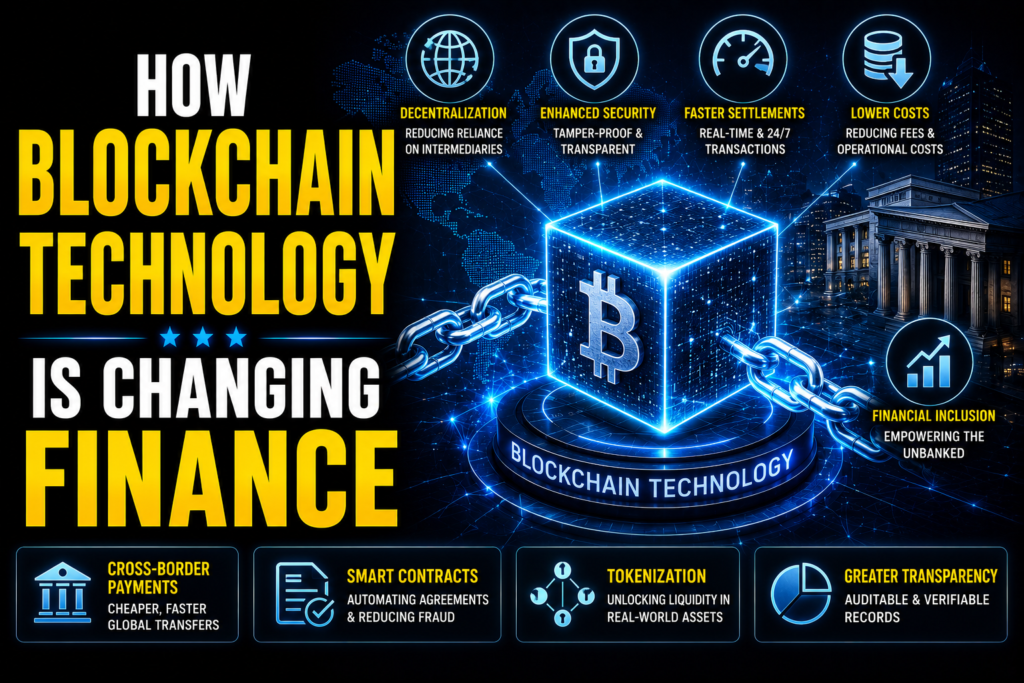
Traditional financial systems often depend on centralized databases maintained by banks, payment processors, and other institutions. Blockchain operates differently by using a distributed ledger that is shared across a network of computers.
Every transaction recorded on the blockchain is verified by network participants and stored in a way that is difficult to alter. This structure creates transparency because participants can verify transaction histories while maintaining security through cryptographic methods.
The decentralized nature of blockchain reduces reliance on a single authority and can improve resilience against certain types of system failures or unauthorized modifications.
Faster and More Efficient Transactions
One of the most promising benefits of blockchain technology is its ability to improve transaction efficiency. Traditional payment systems may involve multiple intermediaries, especially when money moves across borders. These processes can increase costs and create delays.
Blockchain-based systems have the potential to streamline transactions by allowing participants to interact directly through secure networks. This could reduce settlement times and lower operational expenses for financial institutions.
Businesses exploring blockchain often focus on improving payment infrastructure, reducing administrative burdens, and enhancing transparency throughout financial processes.
Increased Transparency and Security
Transparency is a defining characteristic of blockchain technology. Every transaction recorded on a public blockchain becomes part of a permanent ledger that can be independently verified by participants. This visibility can help improve accountability and reduce certain forms of fraud.
Security is another major advantage. Blockchain networks use advanced cryptographic techniques to protect transaction data. Because information is distributed across multiple nodes, altering records without authorization becomes significantly more difficult.
These characteristics have attracted interest from organizations seeking more secure and transparent methods of managing financial information.
The Future of Blockchain in Finance
While blockchain adoption is still evolving, many experts believe its influence on finance will continue to grow. Financial institutions are investing in research and development projects aimed at integrating blockchain into payment systems, asset management, and record-keeping processes.
The technology may also support new financial products and services that were previously difficult to implement using traditional infrastructure. As regulations become clearer and technology improves, blockchain could become a standard component of modern financial systems.
Conclusion
Blockchain technology is changing finance by introducing new ways to process transactions, improve transparency, and enhance security. Although challenges remain, the technology’s potential to improve efficiency and reduce costs has attracted significant attention from businesses and financial institutions. As adoption continues, blockchain is likely to play an increasingly important role in shaping the future of finance.