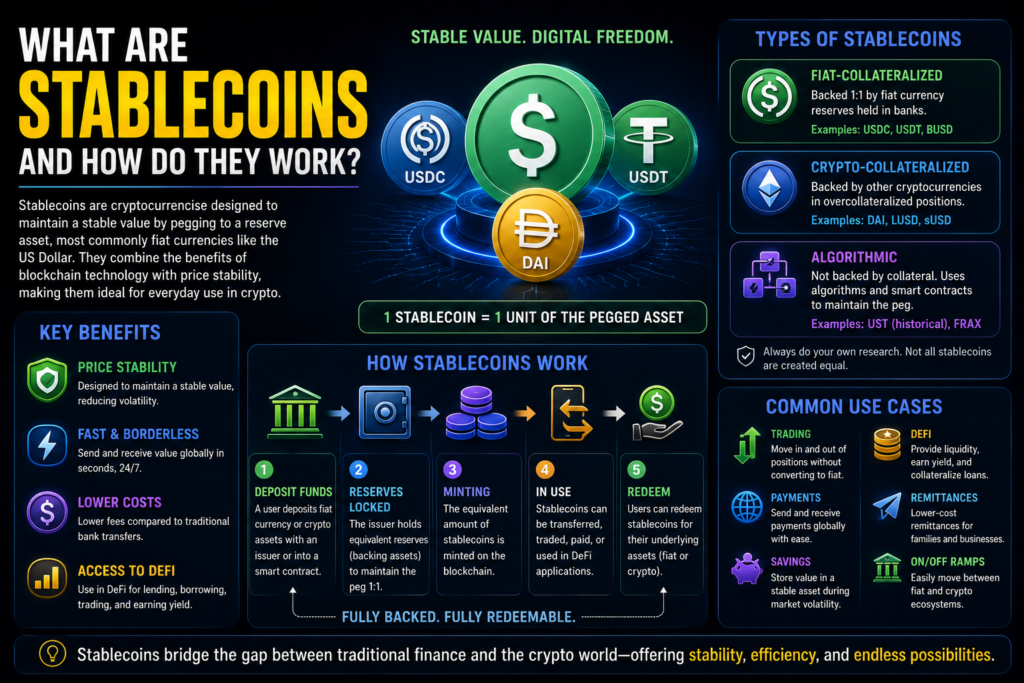
Stablecoins have become one of the most important innovations in the cryptocurrency industry. Unlike traditional cryptocurrencies such as Bitcoin and Ethereum, which can experience significant price fluctuations, stablecoins are designed to maintain a relatively stable value. This stability makes them attractive for individuals and businesses looking to use blockchain technology without being exposed to extreme market volatility.
Understanding the Purpose of Stablecoins
Most stablecoins are linked to traditional assets such as the U.S. dollar. The goal is to provide the speed and accessibility of cryptocurrency while maintaining a predictable value. As the digital asset industry continues to mature, stablecoins are playing an increasingly important role in payments, trading, and financial services.
Their ability to bridge the gap between traditional finance and blockchain technology has made them a key component of the broader cryptocurrency ecosystem.
How Stablecoins Maintain Their Value
The primary purpose of a stablecoin is to reduce volatility. To achieve this, many stablecoin issuers maintain reserves that support the value of the tokens in circulation. In simple terms, each token is intended to represent a specific amount of an underlying asset, such as one U.S. dollar.
When users purchase or redeem stablecoins, the issuing organization adjusts supply and reserves to help maintain price stability. This mechanism is different from cryptocurrencies such as Bitcoin, whose value is determined primarily by market demand and supply.
The concept of stability is particularly appealing for users who want to transfer funds digitally without worrying about large price swings during the transaction process.
Why Stablecoins Have Become Popular
Stablecoins offer several practical advantages that have contributed to their rapid adoption. They provide a convenient way for cryptocurrency traders to move funds between assets without converting back to traditional currencies. This can simplify transactions and improve efficiency within digital asset markets.
Businesses are also exploring stablecoins as payment solutions because they can facilitate faster transfers compared to some traditional payment systems. Since stablecoins operate on blockchain networks, transactions can often be completed quickly and transparently.
The growing demand for digital payments has further increased interest in stablecoins as consumers seek modern alternatives to conventional financial systems.
The Role of Stablecoins in Financial Innovation
Stablecoins have become a foundation for many blockchain-based financial applications. They are widely used within decentralized finance platforms, where users can lend, borrow, and trade digital assets. Because stablecoins maintain a relatively predictable value, they often serve as a practical medium of exchange within these ecosystems.
Financial institutions and technology companies are also studying how stablecoins might improve cross-border payments and reduce transaction costs. These potential benefits have attracted attention from policymakers, businesses, and investors alike.
As innovation continues, stablecoins may become increasingly integrated into both digital and traditional financial environments.
Conclusion
Understanding stablecoins is essential for anyone interested in cryptocurrency and blockchain technology. By combining the efficiency of digital assets with greater price stability, stablecoins offer practical solutions for payments, trading, and financial applications. As adoption continues to grow, they are likely to remain a key part of the evolving digital economy.